writing
-
What Makes Christian Romantic Suspense Different? (And Why Readers Love It)
What Makes Christian Romantic Suspense Different?
If you’ve ever picked up a romantic suspense novel expecting danger, chemistry, and a race against time… Christian Romantic Suspense delivers all of that—but it doesn’t stop there.
It goes deeper.
At first glance, the genre looks familiar. There’s a threat. Someone is in danger and someone else steps in to protect them. Sparks fly—sometimes at the worst possible moment—and the tension builds until something finally breaks.
But in Christian Romantic Suspense, the real battle isn’t just external.
It’s spiritual. In a typical suspense story, the goal is simple: survive. In Christian Romantic Suspense, survival matters—but it’s not the end goal. The deeper question is: Who will you become in the middle of the trial?
Will fear win? Will bitterness take root? Will justice turn into vengeance Or will grace step in and rewrite the ending?
The danger forces characters to confront not just what’s happening around them, but what’s happening inside them as well.
Like mainstream suspense, Christian suspense has broken characters. In fact, you’ll probably find more of them in faith-filled suspense. Ex-cons. Skeptics. People with pasts they’d rather not talk about.
The difference? Their stories don’t end in what they’ve done. Christian Romantic Suspense leans into the truth that no one is beyond redemption—and then puts that belief under pressure. Real pressure, because it’s one thing to believe in grace when life is calm. It’s another to choose it when everything in you wants revenge.
In Christian romantic suspense, the romance isn’t just about attraction—it’s about transformation. These relationships aren’t built on perfect people meeting at the perfect time. They’re built in the middle of chaos, fear, and uncertainty.
Trust has to be earned. Respect has to be chosen. Love shows up as action long before it shows up as words. And often, the biggest hurdle isn’t the danger outside—it’s learning how to trust someone again after everything you’ve been through.
Plus, in true Christian fiction, faith is never a side note. It’s woven into every decision, every turning point, every moment where a character has to choose between what feels right and what is right.
That doesn’t mean the characters have it all together. They don’t. They wrestle. They doubt. They even get it wrong sometimes. But faith is what pulls them back, steadies their footing, and reminds them that they’re not fighting alone.
There’s always a villain in suspense, but in Christian Romantic Suspense, evil isn’t just a plot device—it’s something deeper. Something that distorts, deceives, and destroys. And the fight against it isn’t just physical. It’s moral. It’s spiritual. It matters beyond the final page.
Christian Romantic Suspense has a loyal readership because these stories don’t just entertain. They remind us that:
- Light still breaks through darkness.
- Redemption is still possible.
- Love can still be strong, steady, and sacrificial.
- And even in the middle of chaos… God is still at work.
You get the adrenaline. You get the romance. But you also get something that lingers long after the last page—
Hope.
If Christian Romantic Suspense is your kind of story, the True North Brotherhood series just might interest you. Set in the Pacific Northwest, these stories follow men who’ve walked through fire, found redemption, and now stand in the gap to protect others—while discovering the women God designed to stand—and fight—beside them.
Start with Kage: The 6th Commandment or:
Get a free True North Brotherhood story and step into Cedar Haven today. Where Men Stand
-
How intense is this going to be?
One of the questions readers quietly ask themselves before starting a new book is: How intense is this going to be? Not everyone wants the same level of violence in their reading, and that’s perfectly okay. Some readers enjoy high-stakes action with every punch and gunshot described. Others prefer stories where the danger is real but the camera doesn’t linger on the details.
The tricky part is that authors don’t always spell this out. Fortunately, there are a few clues you can use to get a pretty good idea of what you’re signing up for before you dive in.
Start with the blurb. That’s the description on the back cover or the online book description. It often gives away the story tone. If the language focuses on danger, protecting someone, uncovering secrets, or stopping a killer, the violence is usually present but not graphic. If the description leans heavily into words like brutal, blood-soaked, revenge, or a body count, that’s usually a signal the book may include more detailed or intense scenes.
Next, take a peek at the First Chapter. Authors tend to show their hand early. If the opening chapter starts with a graphic crime scene described in vivid detail, that level of intensity will probably continue throughout the book. On the other hand, if the first chapter focuses more on atmosphere, tension, or introducing the characters, the story is likely relying more on suspense than on graphic violence.
Think of it as the book telling you what kind of ride you’re about to take.
If you’re still unsure, look at the author’s other books. Most writers are fairly consistent with their storytelling style. If their previous books keep the violence mostly off the page, chances are the new one will too. If their stories regularly include very detailed action scenes, that’s likely part of their voice as a writer.
Reader reviews can help you decide as well. People tend to mention if a book is much more intense than they expected. You’ll also want to pay attention to categories. They aren’t perfect, but they do set general expectations. For example, stories built around relationships and personal stakes often keep violence present but not graphic, while high-adrenaline action stories sometimes allow for more intense scenes.
And while this next test is not a hard rule, it can be a helpful if you’re still unsure—study the book cover. Are there elements of violence? Are weapons, dead bodies, or blood evident? You’ll likely find them just as evident in the story.
Every reader has a different comfort level, and that’s part of the beauty of books. There really is something for everyone. A few quick clues from the description, the opening chapter, and the author’s style can usually help you find the story that fits your taste—whether you prefer the tension to stay mostly off-camera or you’re ready for a full-action ride.
After all, the goal of reading isn’t to prove how much you can handle. It’s to find stories you genuinely enjoy.
To that end, I want to explain where the True North Brotherhood series sits on the violence spectrum. Cedar Haven stories contain real danger, but the camera usually stays pulled back. These are not cozy stories where nothing bad ever happens. Crime, corruption, and very real threats exist in Cedar Haven. The men of the True North Brotherhood are often dealing with criminals, protecting vulnerable people, and confronting situations that can turn dangerous very quickly. But the focus of the story is never the violence itself.
When something violent happens, readers usually understand what happened and why it matters, but the scene doesn’t linger on graphic detail. The emotional impact of the moment matters far more than describing the physical mechanics of it.
You might see:
- tense confrontations
- characters in real danger
- fights or gunfire when the story calls for it
What you generally won’t see are long, graphic descriptions meant to shock the reader.
The heart of the Cedar Haven books is redemption, faith, loyalty, and the relationships that grow under pressure. The danger raises the stakes, but it isn’t the point of the story.
If you enjoy stories where the suspense is real but the violence stays mostly off-camera, Cedar Haven will probably feel like a comfortable place to visit—even when things get a little intense.
-
Choosing the Right Danger + Romance Book
Readers sometimes ask how to tell what kind of danger + romance story they’re picking up. Book categories help, but they’re not always consistent. The good news is you can usually tell what level of angst you’re signing up for before you get very far.
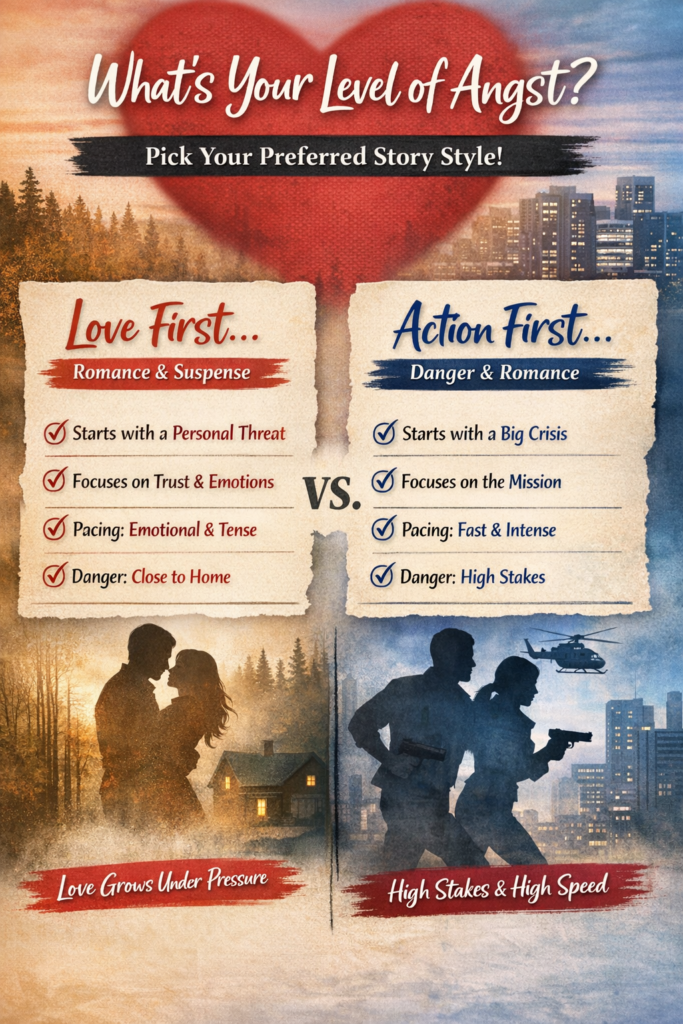
Think of it as choosing your preferred balance of angst. Do you want a heartfelt romance with a side of adrenaline, or an adrenaline rush with a side of romance? The stories I write are built around the growing relationship between the main characters. The danger is real, sometimes very real, but its main job is to push the hero and heroine together and test their trust.
You’ll often see clues right away:
- The story opens with a personal problem or threat aimed at one of the characters
- The hero and heroine quickly find themselves working together
- A lot of page time is spent on trust, secrets, emotional wounds, and growing connection
- The danger feels personal and close to home
In these stories, the emotional journey sits at the center. The mystery or threat matters, but the real question readers are waiting to see answered is whether the two characters will learn to trust each other and build something lasting. If you enjoy a story where love grows under pressure, this is probably your comfort zone.
When the danger drives the story, the narrative focuses primarily on the action side of the equation.These stories often start with a major crisis already in motion—a murder, a conspiracy, a missing person, or some larger plot that needs to be stopped. The characters may meet because of the crisis, and their relationship may grow during the story, but the unfolding danger is what keeps the pages turning.
You’ll often notice things like:
- The opening chapters jump straight into a major event or investigation
- The plot involves wider stakes—organized crime, government secrets, large-scale threats
- The pacing is faster and the focus stays on solving the problem
- The relationship develops along the way rather than driving the story
These are great choices for readers who enjoy higher adrenaline and bigger stakes, with romance woven into the middle of the action.
Both genres combine danger and romance, which is why readers often enjoy both. The difference really comes down to what carries the story forward.
A quick way to think about it is this:
- If you want a story where the relationship is the emotional center and the danger intensifies it, look for books that focus heavily on the characters working together and learning to trust each other.
- If you want a story with bigger action and higher stakes, where the relationship grows in the middle of a larger crisis, choose books that lean more heavily into the investigation or conflict.
Neither approach is better than the other. They simply offer different flavors of tension. And sometimes the most fun part of browsing a new book is deciding just how much angst you’re in the mood for that day.
-
Romantic Suspense vs. Romantic Thriller: What’s the Difference?
If you spend much time browsing book lists, you’ve probably seen the terms romantic suspense and romantic thriller used almost interchangeably. They sound similar—and they are related—but they have several critical differences.
In romantic suspense, the love story sits right at the center of the book. The danger around the characters—whether it’s a crime, a mystery, or someone actively trying to harm them—creates the pressure that pushes the relationship forward.
The hero and heroine usually have to work together to uncover the truth, stop a threat, or simply survive long enough to figure out who they can trust. As the danger grows, so does their reliance on each other. Trust deepens, secrets come out, and the romance develops right alongside the suspense. By the end of the story, readers expect the threat to resolved and the relationship to have reached a satisfying conclusion.
Basically, in romantic suspense, without the romance, the story would have no emotional core.
A romantic thriller shifts the balance the other direction. Here, the thriller plot is the driving force. The story often moves at a faster pace and may involve larger-scale threats—conspiracies, political intrigue, assassinations, or international crime. The romance is still present, but it develops within the larger high-stakes conflict rather than driving the story itself.
The characters may fall in love while navigating the danger, but the relationship isn’t necessarily the main focus of the book. In other words, if you removed the romance, the thriller plot would still work.
A quick rule of thumb looks like this:
- Romantic Suspense: the romance leads the story, and the danger raises the stakes.
- Romantic Thriller: the danger drives the story, and the romance grows along the way.
Both genres blend love and danger, which is why readers often enjoy them for the same reasons. But the difference really comes down to which element sits in the driver’s seat. Either way, there’s something powerful about stories where courage, trust, and love have to grow in the middle of a storm. In my opinion, that’s where some of the best stories live.
-
An Introduction to Cedar Haven

Cedar Haven is a quiet town tucked along Washington State’s northern border—but beneath its peaceful surface, a smuggling ring is taking root.
The True North Brotherhood—men once broken, now redeemed by the blood of Jesus—are determined to walk a new path. As they fight to rebuild their lives, they find themselves drawn into a battle to protect the very town that would rather see them gone.
With a suspicious police force watching their every move and danger closing in, these men must stand in the gap for Cedar Haven’s citizens. And along the way, each will discover the woman God has chosen to stand beside him.
-
Why the Pacific Northwest Is Perfect for Romantic Suspense
There’s something about the Pacific Northwest that feels like it was made for romantic suspense. The atmosphere, the isolation, the beauty mixed with danger—it creates the perfect backdrop for stories where love and risk walk hand in hand.
Here are ten reasons the PNW continues to capture readers’ imaginations.
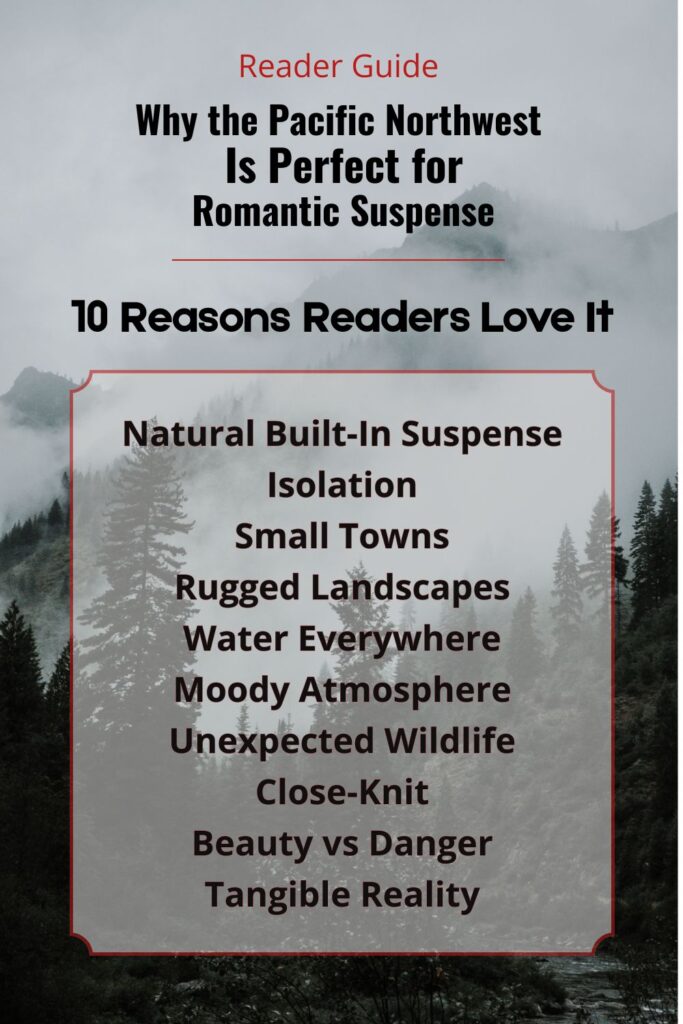
1. Natural Built-In Suspense
Fog. Forests. Storms rolling in off the water.
The PNW doesn’t need help creating tension—it does it all on its own. Visibility drops, paths disappear, and danger can feel just one step away. Rocky shores, cold mist, hidden shoals, and complex currents naturally lend themselves to suspense.
2. Isolation Without Going to the “Middle of Nowhere”
You can have a modern town… and still be completely cut off. I live 4 miles from town but have no cellphone reception. We rely on our satellite dish, and when a storm takes the power out, all connectivity goes down with it.
In both real life and fiction, islands, mountain roads, and dense forests allow people to connect with one another, but not always easily so. A mudslide or a washed out bridge can isolate a home, or even an entire community, for days.
Those kind of factors are a suspense level unto themselves. All an author needs to do is toss in a stalker and bam, instant page turner.
3. Small Towns with Big Secrets
Quiet coastal towns and tucked-away communities create the perfect setting for hidden pasts, long memories, generational grudges, and secrets that never quite stay secret. The suspense builds because everyone knows everyone…or thinks they do.
4. Rugged Landscapes Raise the Stakes
From rocky shorelines to deep forests and mountain terrain, the environment itself can become a threat. Characters don’t just face people—they face mountains, gorges, weather, and distance. Surviving the setting can be a major part of the story.
5. Water Everywhere
Puget Sound, the Pacific Ocean, rivers, inlets, coves, even false bays. Water adds beauty, movement, and danger. It creates natural barriers that hem heroes in—and provide convenient escape routes for the bad guys.
6. A Moody, Atmospheric Tone
The PNW has a distinct emotional feel: overcast skies, filtered light through trees, and quiet, reflective settings. It naturally supports stories that are introspective, emotional, and layered with tension.
7. Wildlife and the Unexpected
This is a place where nature is still very present. Whether it’s as mundane as a barking dog sensing danger, something unknown moving in the trees, or wildlife complicating a scene…it can add unpredictability without forcing it.
8. Close-Knit Communities
In smaller PNW settings, people rely on each other. That creates strong dynamics for found family, loyalty, and layered conflict when trust is broken, which naturally lend themselves to romantic suspense themes.
9. The Contrast of Beauty and Danger
Few places balance peaceful beauty and real risk as naturally as the PNW. A quiet shoreline can become a crime scene. A scenic trail can become a place of confrontation. Remote cabins face isolation from weather, fire, or even mechanical failure.
That contrast between beauty and danger heightens every emotional beat. Imagine an intrepid heroine admiring the majesty of a storm swollen stream pouring over a precipice as a killer sneaks up behind her…
10. It Feels Real
The Pacific Northwest isn’t an abstract setting—it’s vivid, specific, and grounded. Readers don’t have to imagine what cedar might smell like, the chill in the air, the sounds of water pounding against rock, or the stillness of a snow-blanketed forest. Real elements help create the danger, and that realism makes the scene feel personal and more immediate, which in turn makes the romance more meaningful.
The Pacific Northwest offers something rare in romantic suspense—a setting where atmosphere, danger, and emotion naturally work together. It doesn’t just support the story, it is an inseparable part of the action and adventure, naturally shaping the nature of the romance, especially for readers who enjoy the forced-proximity trope.
Where can you find these elements in the True North Brotherhood novels?
I’m so glad you asked.
Where Men Stand features big secrets, close knit community, and found family.
Kage: The 6th Commandment features small town secrets and long memories, a tightly knit community, found family, rugged landscapes, and isolation.
A Cedar Haven Christmas features a tightly knit community, found family, rugged landscapes, isolation, and weather challenges.
-
Explore Kage: The 6th Commandment Through Reader Feedback
-
ARC Reader Response!
Wow, I really enjoyed this book!! Great first novel. Can’t wait to read Katy’s & Gar’s story, & hopefully Ty’s, too. Really one of the best romances I’ve read in a good while. Authentic in setting & in attraction/desire & in fears. Reminds me a little of Janith Hooper’s books, while in a more modern setting. Well-edited & nothing too major in proofreading, mostly just little things. The angst dragged on a little near the end, but I can see why. It was a great example of sacrificial love & patience. Ruth was strong, but Boaz made sure to protect her in his fields. He also finagled a way to ensure he could marry her, which reminds me a little of Griffin’s hiring of Bella. Loved it!
ARC ReaderWhoohoo! I know that all my reader responses won’t be great, but I like this start.
-
55 Flash Fiction ~ Skip It
After Jack’s family moved from Australia to America, Jack came home within an hour of being left in his first grade classroom. “These yanks are mental,” he said. “I ain’t no sheila and I’m not going back!”
“Whatever happened?” His mum asked.
“Teacher says I gotta skip to the loo!”
~*~
In memory of G-Man’s 55 Flash Fiction Friday. [Write a story in exactly 55 words.]
-
The Old Lady and The Clothes Shrinkers
Natalina was a quick-witted, feisty old broad. She lived alone in a quaint little castle on the edge of Snowmania, but she wasn’t lonely. Natalina had a large, extended family and many friends. She also kept quite busy with charitable causes. One of her favorite philanthropies involved promoting small businesses. Her favorite slogan was, “Nurture your community and it will nurture you!”
Every Sunday, Natalina and her daughters nurtured a specialty bakery on Plumpton Street. They bought donuts for breakfast, tarts for lunch, and cannoli for dinner.
Every Monday, Natalina and her Civic Minded Voters For Honesty, Integrity, & Intelligence, signed up future voters, then adjourned to Gordo & Gordo Taqueria for enchiladas and Margaritas. And, Natalina always bolstered her favorite neighborhood deli on the way home by purchasing a triple-decker ice cream cone.
On Tuesdays, Natalina supported her local mom and pop grocery store. Food shopping days always included a nurturing stop at Lindt Candy Emporium for a pound or two of bonbons.
On Wednesdays Natalina volunteered at a local soup kitchen. After six hours of helping cook, serve, and clean up the huge community meal, she was too tired to go home and cook her own meal, so she often stopped off at The Spicy Meal Ball for pasta; although sometimes she instead supported The Gourmet Veggie Cafe and had a nice healthy salad, followed by a wee slice of pecan-crusted sweet potato pie and a tiny scoop of frozen yogurt.
Thursdays were housecleaning days. Natalina scrubbed, dusted, vacuumed, and polished her little castle until it was squeaky-clean. Once the house was in pristine order, she couldn’t sully her kitchen by cooking in it. Sometimes she would go out to eat, but usually she just called Antonio’s and ordered pizza.
Fridays were Natalina’s “chill” days. She’d spend the day eating junk food and watching Netflix. One simply had to stay home sometimes.
Of course, Saturdays were the best day of the week. They usually involved a road trip and overflowed with family and food and laughter. They whole family would help fill the cash register at Gravy Granny’s Diner before hitting the road. Some of the family members were adventurous and tried Granny’s fried-breakfast skillets, but Natalina always had biscuits and gravy. Lunch was generally a quick snack purchased from a food truck or cart vendor as they strolled through parks or in and out of art galleries. Dinner was an adventure. Every Saturday night the Natalina clan went to some restaurant none of them had previously tried. Sometimes they had to drive as far as 50 miles to make that happen.
Natalina built a fabulous life for herself, and while doing so, still managed to support a good many of the local businesses in her community. And then it happened — one Saturday as she tried to dress, her favorite pants were too tight to zip. The next week, several of her shirts wouldn’t button.
At first Natalina thought it was her imagination, but when garment after garment refused to fit, she had to face the truth: every day when she left her home, somebody broke into her house and alteried her clothing. She called the cops. They laughed at her and told her to diet. Of all the nerve! (She scratched buying tickets to the Policeman’s Annual Crab Feed Fund Raiser off her to-do list.) After all, she was far too busy supporting the community to get fat. She only took one day off a week!
Natalina knew what she had to do — hire a private detective! Of course she hired someone local. He watched her house for a week, and despite the fact that even her trendy jogging suits (which she never jogged in) were also getting smaller, he didn’t catch anyone sneaking in and out of her house. Then he, too, suggested she diet. Natalina realized he must be in league with whoever altered her clothing.
She decided to hire a detective from “away,” but first she had to buy new clothes. Despite being somewhat miffed at her neighbors, she still shopped at local boutiques. Unfortunately, buying new clothes cut down on the amount of money she had to spend in support of the local eateries. It was sad, but what could she do? Wearing clothes in public was polite, and Natalina was never deliberately discourteous.
She wasn’t made of money, so it took her several months to replace her wardrobe. In all that time she only managed to eat out once or twice per week. Sadly, Lindt Candy Emporium and Antonio’s pizza went out of business. New clothing shops opened up in their place. One of them specialized in trendy jogging suits. Natalina bought several.
Once her closest was re-filled, Natalina turned her thoughts to hiring another private detective, but found she had no need. Her clothes had stopped shrinking. She sat and pondered the mystery and in no time the answer came to her. It was the clothing shop owners! They had been jealous because she hadn’t been spending her support dollars evenly!
As I mentioned previously, Natalina was very civic-minded. She forgave the garment shop owners because, after all, they were part of her community and deserved to be nurtured, too. That’s when she realized she needed to support the flower shop, the nail salon, the bookstore, and a variety of other local entrepreneurs. When Natalina started spending her money more judiciously, the clothes shrinkers disappeared, proving her theory. And once again Natalina was content with her fabulous life in her quaint little castle on the edge of Snowmania.